
Stop doing everything manually. Here's how to actually grow your brand with AI
A no-fluff guide for Gen Z and Millennial founders who are ready to stop spinning their wheels and start building something real.

Real talk: starting a business in 2025 is both the best and most overwhelming thing you can do. You’ve got more tools, more platforms, more “growth hacks” thrown at you than any generation before. Everyone online seems to have it figured out. And here you are, staring at a blank Instagram grid, three half-written captions in your notes app, wondering where to even start.
I’ve been there. And after years of building brands — for clients from bootstrapped solo founders to fast-scaling DTC products — I can tell you the difference between the ones who grow and the ones who stall isn’t talent, budget, or even the idea. It’s leverage. The smart ones find it fast. Right now, the biggest leverage available to any new founder is the combination of AI and focused digital marketing. Let me break down exactly how to use both.
The honest problem nobody wants to say out loud
You’re a digital native. You’ve been on social media since before it was cool to admit it. But there’s a huge gap between scrolling TikTok at midnight and actually building a brand presence that converts strangers into customers. The personal-use muscle and the business-growth muscle are almost completely different. Knowing that isn’t a weakness — it’s step one.
The game has changed. You don’t need a marketing department, a $10k ad budget, or a degree in communications. You need a clear strategy, the right tools, and the willingness to show up consistently. AI handles a massive chunk of the heavy lifting now. Here’s exactly how.
Your AI toolkit (the stuff that actually works)
AI isn’t just a buzzword anymore — it’s a practical shortcut for everything that used to eat up hours of your day. Here are the three areas where it makes the biggest immediate difference for a new founder:
1. Content ideation — never stare at a blank screen again
The number-one reason founders go quiet online is because they run out of ideas. With tools like ChatGPT or Claude, you can generate 30 TikTok or Reels ideas in literally three minutes. Try a prompt like: “I sell handmade silver jewellery. Give me 25 short-form video ideas targeting women aged 25–35 who value craft and sustainability.” You’ll get a content calendar’s worth of hooks in one go. That’s a full month of ideas before you’ve had your morning chai.
2. Copywriting — your captions, emails, and ad copy on autopilot
Writing good copy (that’s the words that make people stop scrolling and actually want to buy) used to take real skill or real money. Now? You feed the AI your product, your vibe, and your target customer — and it spits out options you can tweak in minutes. Use it for Instagram captions, welcome emails to new subscribers, even the tiny line of text that shows up in Google when people search for you. Don’t copy-paste it wholesale — add your voice — but let it do the structural heavy lifting.
3. Visuals — look premium without the premium price tag
No design budget? Not a problem. Canva’s AI tools (Magic Design, Text to Image) and standalone tools like Midjourney can generate product mockups, branded social templates, and scroll-stopping hero images in minutes. The bar for visual quality on social is high — but it’s achievable without hiring a designer on day one.
ChatGPT / Claude
Ideation, captions, email drafts, strategy brainstorming
Canva AI
Branded templates, social graphics, product mockups in minutes
Midjourney
Hero images, mood boards, custom illustrations for your brand
CapCut / Descript
AI video editing, auto-captions, trending transitions fast
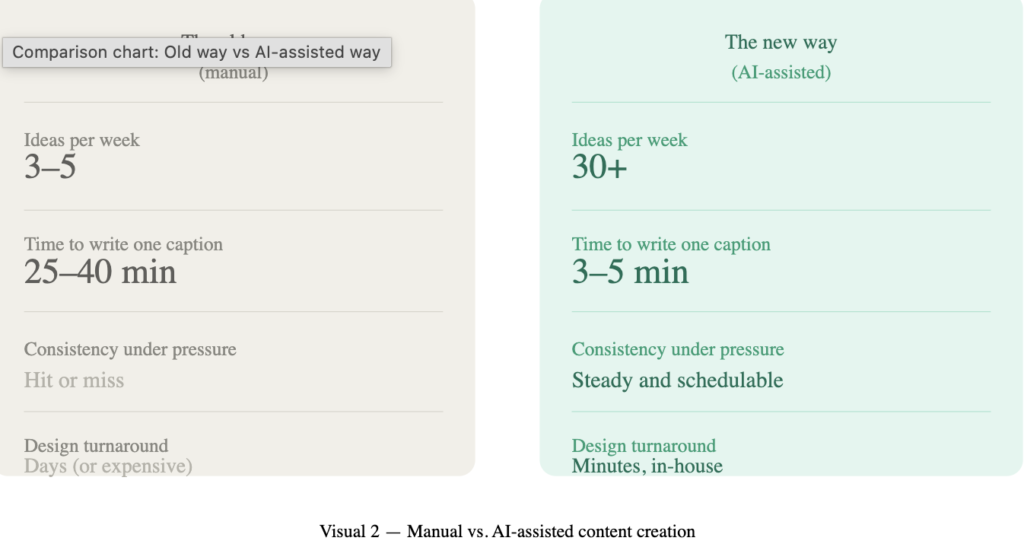
Old way vs. new way — a real comparison
Here’s what the content creation process looked like before versus what it looks like now when you’re working smart:
The marketing angle: what actually works for your audience
Here’s where most new founders waste their energy: trying to be everywhere. TikTok, Instagram, LinkedIn, YouTube, Twitter/X, Pinterest — nope. Pick one or two platforms and go all in. For most product-based or lifestyle brands, that’s TikTok or Instagram Reels. For B2B founders or consultants, LinkedIn is your lane. You can always expand later.
And then there’s the mindset shift that changes everything: authenticity beats polish. The era of perfectly curated grids is over. Your audience — especially if they’re Gen Z or younger Millennials — has a finely tuned radar for fakeness. A slightly shaky phone video of you explaining why you started your brand will outperform a studio-shot product photo almost every time. Show the process, the failures, the behind-the-scenes. That’s the content that builds community, and community is what turns followers into buyers.
Don’t broadcast at your audience — build with them. Reply to comments. Ask for their opinions. Feature their content when they post about you. This is community building, and it’s the real long game that no ad spend can shortcut.
The funnel that turns strangers into customers
Marketing works in stages. A stranger doesn’t buy from you the first time they see you — they need to know you, then trust you, then want what you’ve got. Here’s the simple version of how that journey works:
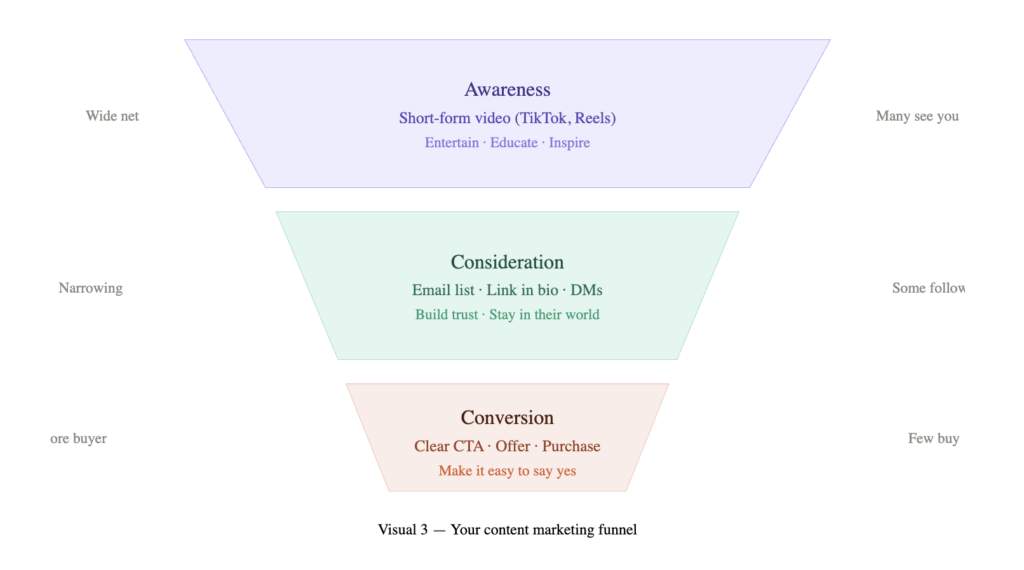
The short-form video gets you discovered. Your email list (yes, still incredibly powerful — it’s the one platform nobody can take away from you) keeps people warm. And the conversion stage is where you make the ask — a clear, simple offer with an obvious next step. Most founders obsess over the top of the funnel and neglect the middle. Don’t. Growing an email list from day one is one of the best moves you can make.
Your 30-day action plan (no overwhelm edition)
Week 1: Pick your primary platform. Set up your profile completely. Use ChatGPT or Claude to generate 20 content ideas in your niche. Write down your brand’s one-sentence story.
Week 2: Post 3–5 times. Don’t overthink it. Talking-head videos explaining your product, your origin story, or a common question in your space. Use Canva AI for any graphics. Engage with every comment, even if it’s just a reply emoji.
Week 3: Set up a free email list (Mailchimp or Kit — both free to start). Create a simple lead magnet (a discount, a free guide, a behind-the-scenes PDF) to give people a reason to sign up. Link it in your bio.
Week 4: Review what worked. Which posts got the most saves, shares, or comments? Do more of that. The algorithm is basically a mirror — it shows more people what your audience already liked.
.